Abstract
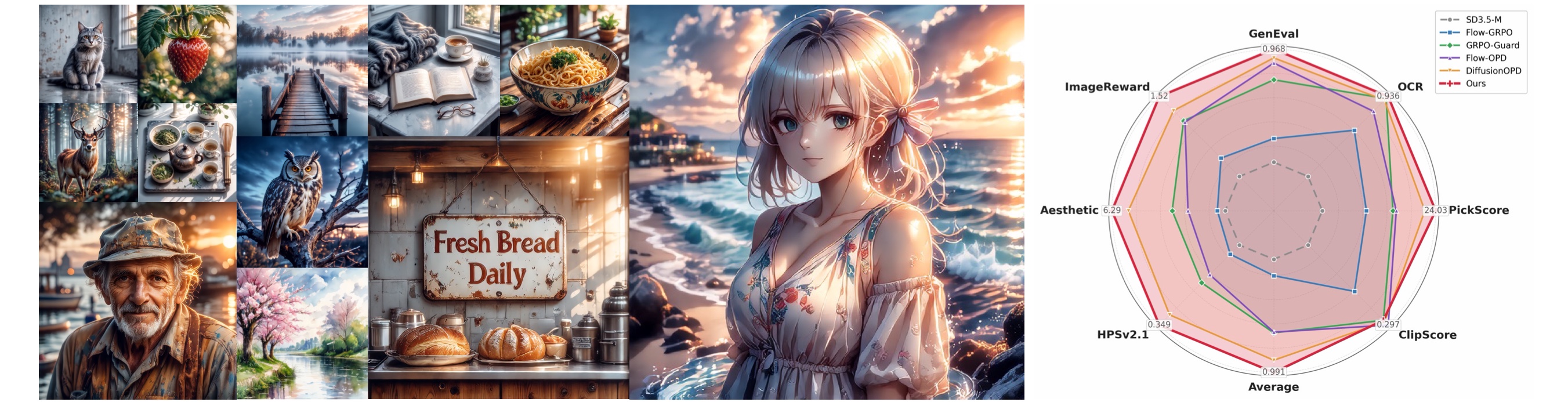
Flow-matching models are now a mainstream method for image generation, but their adaptation to diverse downstream scenarios typically relies on post-training, which may cause conflicts among task-specific optimization objectives. Reinforcement learning enables direct optimization of task-specific rewards beyond the original models, yet trajectory-level optimization may incur high-variance gradients and cross-task interference. On-policy distillation (OPD) offers dense and stable supervision on student rollouts, but conventional teacher matching remains imitation-based. We propose DreOPD, a Degraded-reference extrapolative OPD method for flow-matching models that bridges these two paradigms. DreOPD converts implicit reward extrapolation into closed-form velocity regression, enabling extrapolative post-training with the stability of OPD. It further uses a mildly degraded reference to strengthen the teacher–reference contrast, yielding a clearer extrapolation direction. Experiments on single- and multi-teacher settings show that DreOPD outperforms OPD and multi-task RL baselines in average performance, while surpassing specialized teachers on most metrics.
Motivation
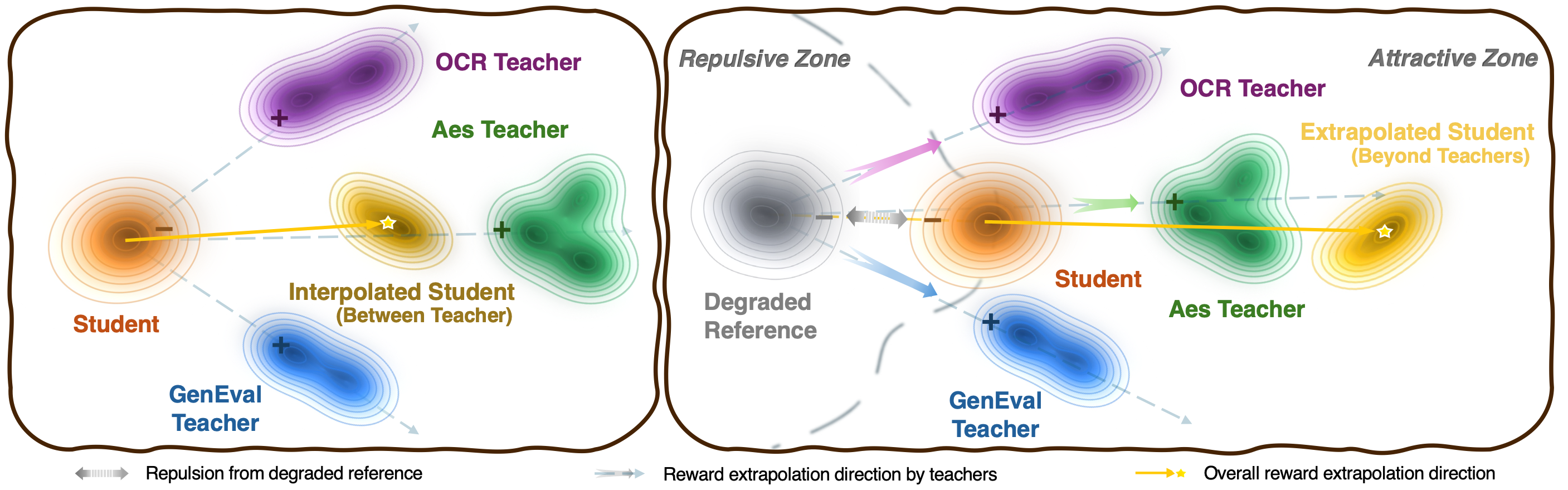
Deploying flow-matching models across objectives such as prompt following, text rendering, and aesthetics exposes a fundamental trade-off. Reinforcement learning can improve beyond existing models but suffers from high-variance trajectory-level gradients and cross-task interference. On-policy distillation is stable and dense, but imitation-based: a shared student merely interpolates among specialized teachers rather than exceeding them.
- Beyond imitation. We derive a closed-form target that extends flow-based OPD from teacher imitation to reward extrapolation.
- Reward interpretation. We characterize conditions under which the teacher–reference contrast is reward-aligned, and introduce controlled reference degradation to strengthen it.
- Strong results. Across single- and multi-teacher settings, DreOPD achieves the best average performance while surpassing specialized teachers on most metrics.
Method
DreOPD converts trajectory-level implicit reward extrapolation into a per-state, closed-form velocity target, so that extrapolative post-training reduces to stable velocity regression on student rollouts.
1. Implicit reward extrapolation objective
Generalized OPD reinterprets teacher matching through the implicit reward log(πT/πref) and introduces a scaling coefficient λ. At λ=1 the reference terms cancel and it reduces to reverse-KL teacher matching; the regime λ>1 (ExOPD) amplifies the teacher–reference contrast beyond imitation.
2. Closed-form extrapolated velocity target
Under shared-covariance Gaussian flow transitions, the conditional objective at each student-visited state is strongly convex in the velocity and admits a unique closed-form optimizer. This turns a trajectory-level contrast into a simple per-state target, avoiding likelihood-ratio gradients over the denoising path.
At λ=1 this recovers teacher imitation vλ⋆=vT; for λ>1 it moves beyond the teacher along the teacher–reference direction. The displacement from the teacher makes the roles of extrapolation strength and reference explicit:
3. On-policy velocity regression
We train the student by regressing toward the (stop-gradient) target on its own current rollouts, giving dense and stable supervision with the extrapolative direction baked into the target.
4. Reward interpretation & degraded reference
At the distribution level, the optimum is a reward tilt of the reference, and the expected reward increases monotonically with λ. Since the step beyond the teacher scales with vT−vref, a mildly degraded reference enlarges this reward-aligned contrast while preserving generative structure, strengthening extrapolation.
Results
We evaluate DreOPD with SD3.5-M at 512×512 across three text-to-image objectives: compositional correctness (GenEval), text rendering (OCR), and aesthetic quality (PickScore, ClipScore, HPSv2.1), plus out-of-domain Aesthetic and ImageReward.
Single-Teacher Distillation
| Method | GenEval | OCR | PickScore | ClipScore | HPSv2.1 |
|---|---|---|---|---|---|
| SD3.5-M (w/o CFG) | 0.2529 | 0.1377 | 20.519 | 0.2384 | 0.2052 |
| SD3.5-M | 0.6273 | 0.5079 | 22.331 | 0.2837 | 0.2795 |
| Teacher | 0.9470 | 0.9239 | 24.034 | 0.2963 | 0.3460 |
| Flow-OPD | 0.9501 +.0031 | 0.9279 +.0040 | 24.006 −.028 | 0.2957 −.0006 | 0.3445 −.0015 |
| DiffusionOPD | 0.9648 +.0178 | 0.9246 +.0007 | 24.008 −.026 | 0.2955 −.0008 | 0.3454 −.0006 |
| Ours (w/o DeRef.) | 0.9708 +.0238 | 0.9322 +.0083 | 24.034 +.000 | 0.2946 −.0017 | 0.3492 +.0032 |
| Ours | 0.9710 +.0240 | 0.9364 +.0125 | 24.037 +.003 | 0.2955 −.0008 | 0.3497 +.0037 |
Single-teacher distillation on three independent tasks. GenEval and OCR are reported by their respective students; PickScore, ClipScore, and HPSv2.1 by the aesthetics student. The Teacher row combines the in-domain scores of three task-specific teachers. Bold: best. Subscripts show absolute changes from the corresponding teacher (green = gain, red = drop). DeRef. = degraded reference.
Multi-Teacher Distillation
| Model | GenEval | OCR | PickScore | ClipScore | HPSv2.1 | Aesthetic | ImgReward | Average |
|---|---|---|---|---|---|---|---|---|
| SD3.5-M (w/o CFG) | 0.2529 | 0.1377 | 20.519 | 0.2384 | 0.2052 | 5.161 | −0.5471 | 0.0000 |
| SD3.5-M | 0.6273 | 0.5079 | 22.331 | 0.2837 | 0.2795 | 5.396 | 0.8324 | 0.5219 |
| Single-Task RL Teachers | ||||||||
| GenEval Teacher | 0.9470 | 0.6286 | 20.084 | 0.2870 | 0.2644 | 5.246 | 0.8976 | 0.5755 |
| OCR Teacher | 0.6562 | 0.9239 | 22.225 | 0.2919 | 0.2720 | 5.266 | 0.8881 | 0.5963 |
| Aes Teacher | 0.4935 | 0.5014 | 24.034 | 0.2963 | 0.3460 | 6.232 | 1.5071 | 0.8120 |
| Multi-Task RL | ||||||||
| Flow-GRPO | 0.7399 | 0.7673 | 22.677 | 0.2893 | 0.2901 | 5.469 | 1.0539 | 0.6527 |
| GRPO-Guard | 0.9002 | 0.9278 | 23.197 | 0.2959 | 0.3137 | 5.824 | 1.3582 | 0.8394 |
| DiffusionNFT | 0.9510 | 0.9491 | 23.182 | 0.2869 | 0.2812 | 5.399 | 1.0699 | 0.6939 |
| Cascade NFT | 0.9376 | 0.8827 | 23.803 | 0.2920 | 0.3305 | 6.006 | 1.4907 | 0.9029 |
| On-Policy Distillation | ||||||||
| Flow-OPD | 0.9395 −.0075 | 0.8756 −.0048 | 23.262 −.772 | 0.2975 +.0012 | 0.3070 −.0039 | 5.692 −.540 | 1.3251 −.182 | 0.8189 |
| DiffusionOPD | 0.9607 +.0137 | 0.9242 +.0003 | 23.980 −.054 | 0.2962 −.0001 | 0.3422 −.0038 | 6.191 −.041 | 1.5017 −.0054 | 0.9680 |
| Ours (w/o DeRef) | 0.9668 +.0198 | 0.9281 +.0042 | 24.032 −.002 | 0.2956 −.0007 | 0.3487 +.0027 | 6.239 +.007 | 1.5172 +.0001 | 0.9841 |
| Ours | 0.9681 +.0211 | 0.9362 +.0123 | 24.035 +.001 | 0.2959 −.0004 | 0.3487 +.0027 | 6.292 +.060 | 1.5245 +.0174 | 0.9939 |
Single-task RL, multi-task RL, and multi-teacher OPD. Bold: best; Blue rows: Ours; Gray cells: in-domain reward. Average is the mean of min-max normalized scores across all metrics. Subscripts show absolute changes from the corresponding teacher. DreOPD reaches the best average (0.9939) and surpasses teachers on most metrics.
Ablation Studies
Impact of the extrapolation factor λ
| λ | GE | OCR | Pick | Clip | HPS | Aes | IR |
|---|---|---|---|---|---|---|---|
| 0.5 | .921 | .899 | 23.707 | .2941 | .3241 | 6.03 | 1.411 |
| 0.75 | .950 | .918 | 23.925 | .2961 | .3364 | 6.13 | 1.483 |
| 1.0 | .958 | .926 | 23.988 | .2963 | .3426 | 6.20 | 1.504 |
| 1.25 | .968 | .936 | 24.034 | .2959 | .3487 | 6.29 | 1.525 |
| 1.5 | .961 | .938 | 24.019 | .2945 | .3505 | 6.26 | 1.523 |
Ablation on λ. In-domain: GenEval (GE), OCR, PickScore (Pick), ClipScore (Clip), HPSv2.1 (HPS); OOD: Aesthetic (Aes), ImageReward (IR). Bold: best. Extrapolation (λ>1) improves over teacher matching, peaking around λ=1.25.
Degraded reference construction
| Method | GE | OCR | Pick | Clip | HPS | Aes | IR | Avg. |
|---|---|---|---|---|---|---|---|---|
| w/o DeRef. | .967 | .928 | 24.03 | .2956 | .3487 | 6.24 | 1.517 | .558 |
| Reference Velocity Quantization | ||||||||
| 4-bit | .962 | .923 | 24.03 | .2950 | .3482 | 6.28 | 1.524 | .566 |
| 8-bit | .968 | .936 | 24.04 | .2959 | .3487 | 6.29 | 1.525 | .926 |
| Reference Weight Quantization | ||||||||
| 4-bit | .959 | .920 | 23.96 | .2929 | .3489 | 6.30 | 1.523 | .372 |
| 8-bit | .961 | .931 | 24.05 | .2949 | .3490 | 6.28 | 1.525 | .739 |
| Reference Velocity Gaussian Perturbation | ||||||||
| σ = 0.01 | .959 | .923 | 24.01 | .2954 | .3477 | 6.27 | 1.520 | .358 |
| σ = 0.1 | .960 | .925 | 24.04 | .2948 | .3491 | 6.28 | 1.521 | .594 |
Ablation on the degraded reference. Bold: best. Mild velocity quantization (8-bit) yields the strongest, most structurally faithful teacher–reference contrast; overly aggressive degradation captures corruption artifacts rather than task-relevant differences.
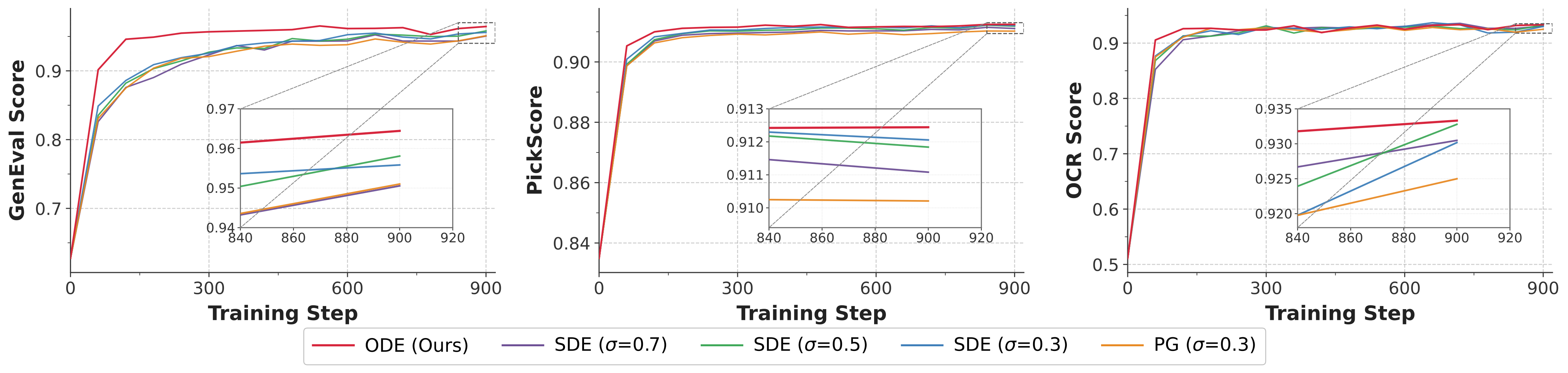
Noise level & sampling
Additional Qualitative Results
Additional examples across the three objectives. Use the tabs to switch between tasks.

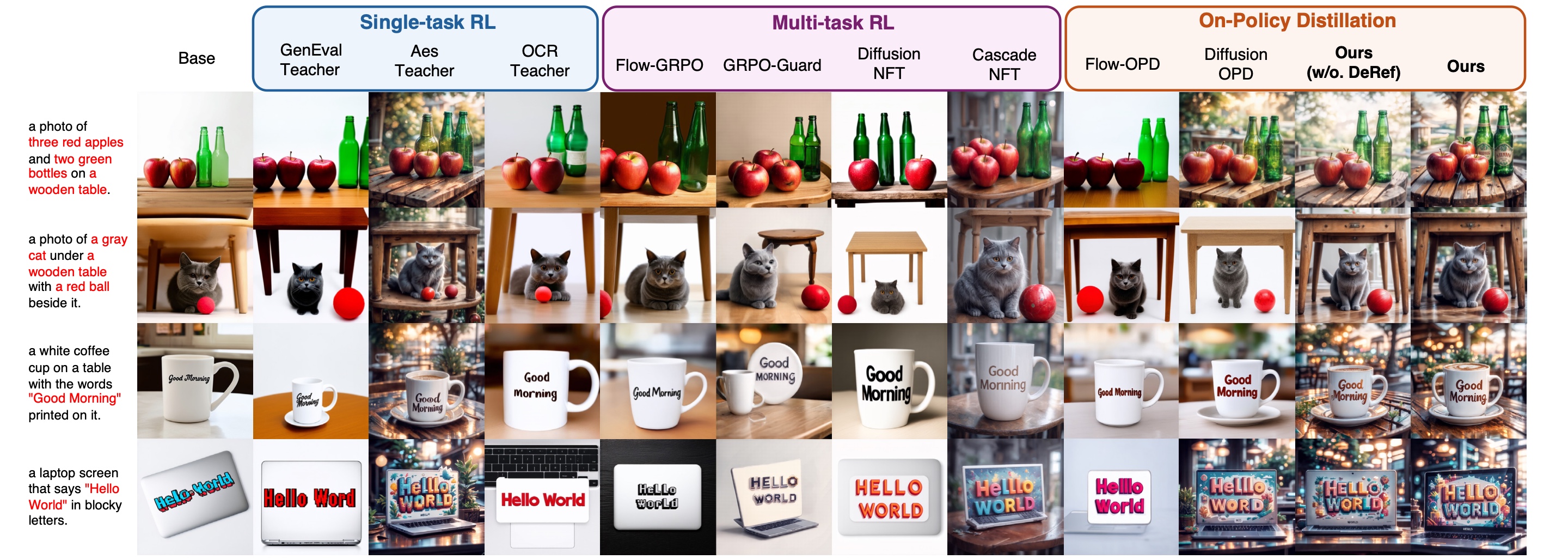
Compositional prompt following. Examples cover counting, color recognition, spatial relations, and attribute binding.

Text rendering. Examples include short text, long text, and complex backgrounds.
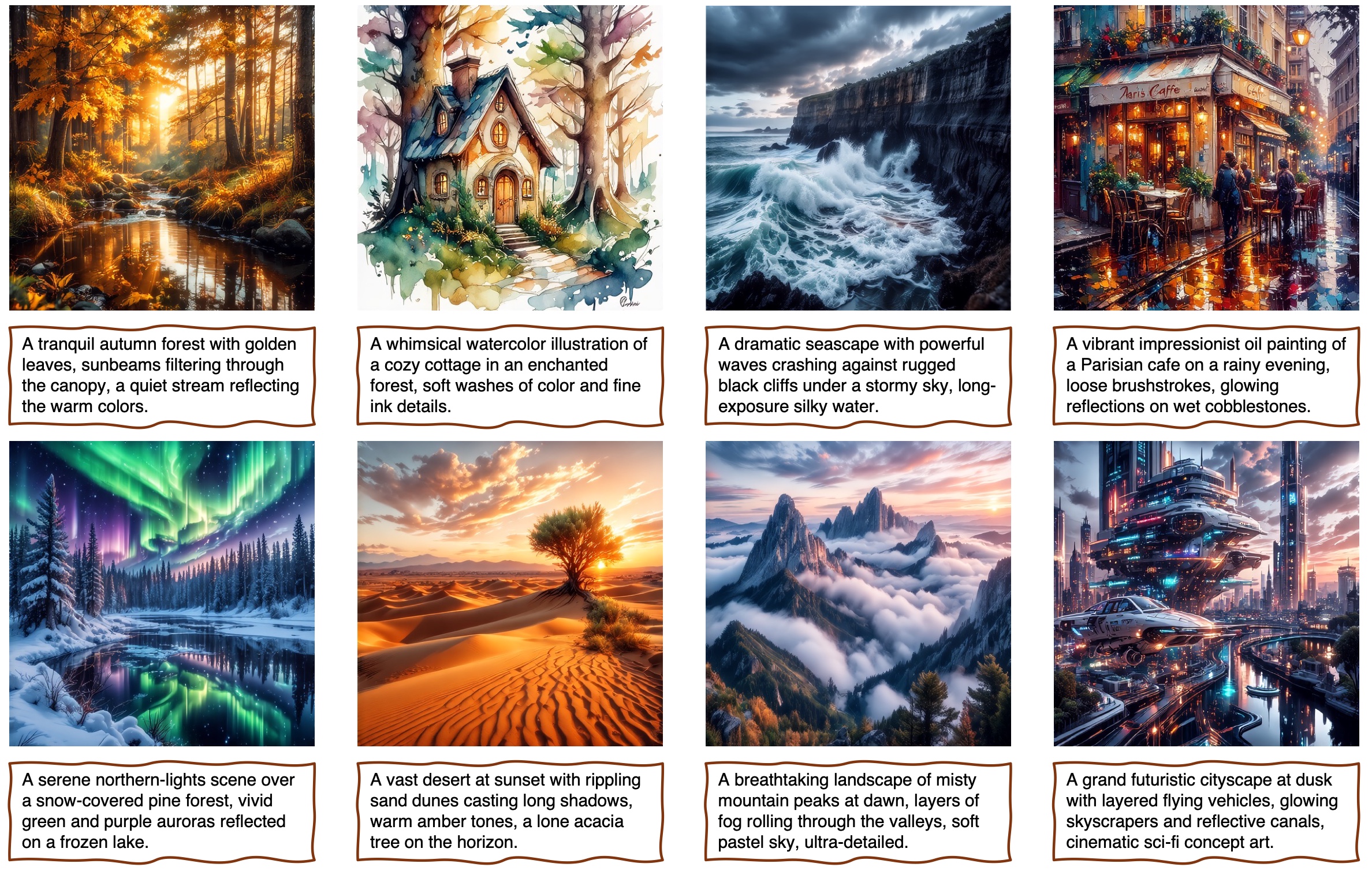
Aesthetic generation. Examples cover natural scenes, artistic styles, and complex compositions.
Conclusion
DreOPD translates trajectory-level implicit reward extrapolation into a closed-form velocity target, extending on-policy distillation from teacher imitation to teacher–reference extrapolation while retaining regression-based training. A mildly degraded reference strengthens a reward-aligned contrast without disrupting generative structure. Across single- and multi-teacher settings, DreOPD achieves the best average performance while surpassing teachers on most metrics, establishing reward extrapolation as an effective framework for consolidating specialized flow models.
BibTeX
@article{lin2026dreopd,
  title={DreOPD: Degraded-Reference Extrapolative On-Policy Distillation for Flow-matching Models},
  author={Lin, Mingfeng and Cai, Chengfei and Xu, Lin and Wei, Yuxiang and Han, Liang},
  journal={arXiv preprint arXiv:2608.09233},
  year={2026}
}